Effect of vegetation and noise barriers on air quality
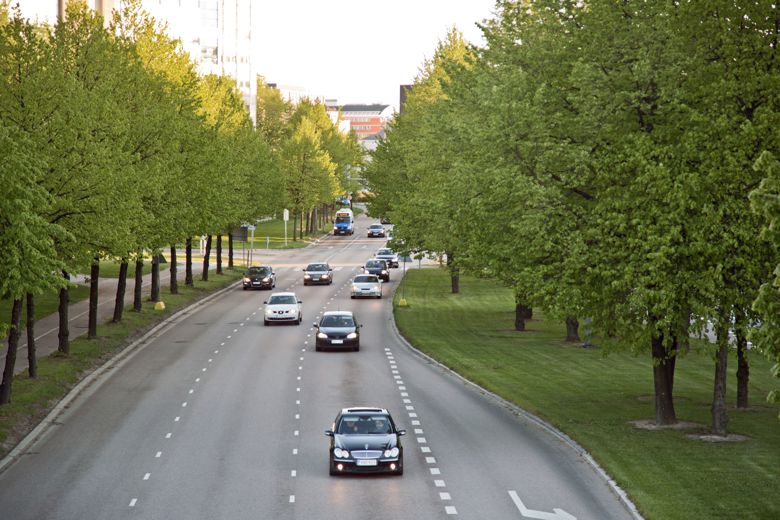
The effects of vegetation on the dilution of air pollutants have been studied in several different countries and cities. Studies conducted in Finland have not found vegetation to have a significant impact on the concentrations of air pollutants. Low vegetation, such as shrubs, vines, green roofs and grass, can slightly reduce pollution levels. However, planted areas can create additional distance between a traffic route and housing, which reduces the concentrations of air pollutants at the site. In Finland, deciduous trees and many shrubs are leafless most of the year, and leafless vegetation has little effect on air quality.
Studies have shown that densely planted and tall trees as well as wide crowns hinder the dilution of pollutants and can even worsen the air quality in street canyons. Tall trees with narrow crowns do not hinder the dilution as much as those with wide crowns. However, vegetation improves the comfort of environments.
Street dust can be combated with a weak saline solution. Almost all plants suffer from salt. Salt has a detrimental effect especially in the spring, when plants start coming to life.
The impact of noise barriers on air quality has been studied in the Helsinki metropolitan area. The most recent study was conducted along Turunväylä (Turku Motorway) during the winter and spring of 2023. Measurement campaigns showed that high noise barriers can improve air quality immediately behind the barrier on the sheltered side, close to the ground. Noise barriers provide greater protection from road dust than from vehicle exhaust emissions. However, the protective effect of a barrier on traffic-related emissions diminishes rapidly farther away behind the barrier. The higher the barrier, the stronger and more extensive its effect on pollutant concentrations. Noise barriers increase concentrations between the roadway and the barrier, at the ends and above the barrier, and redirect the traffic-emission plume to higher elevations.
Distance from the roadway has a greater impact on pollutant concentrations than the presence of a noise barrier. Therefore, buffers or setback distances, together with other measures that reduce emissions and human exposure, are important considerations in urban planning. Exposure to air pollutants can be significantly reduced by locating residential buildings and sensitive sites sufficiently far from major roads.
Updated :
07.09.2026 09:53